Why should you visit the Gupteshwor Cave?
Lord Shiva is worshiped in this cave, and many visitors gather here during festivals like Chaite Dashain, Balachaturdashi, and Mahashivratri. You can find structures made from rare minerals and elements by wandering underground. All caves around the world always look mysterious, but Gupteshwor Mahadev Cave is extraordinary because it also has a religious background.
It is believed that visiting the cave will fulfill the desire for freedom from suffering; the childless couple is blessed with their offspring and provides rescue in disaster. Although it is a concept to promote the cave from a religious point of view, it seems appropriate to open it for scientific study.
Accommodation is not a problem here, as Kushma Bazar has comfortable hotels, lodges, and restaurants.
The peaceful atmosphere of the cave soothes one’s senses and allows one to reflect for a while. It is an excellent place to spend some quiet time amidst the usual hustle and bustle of the city.
Best time to visit Gupteshwor Mahadev Cave
Gupteshwor Cave is open to the public all year round. The cave’s climate does not depend on external weather conditions, so the temperature inside is always equally comfortable, around 8-10 °C.
The busiest season is summer. Many have holidays and vacations during this period, so if you prefer to avoid the crowd, choose other months.
On the other hand, Nepal is a beautiful country, and you will undoubtedly want to see its other attractions. It is most convenient to do this in the warm season, which means that the best time to visit is late spring (March to late June) or early autumn (September to November). The weather is already ideal for traveling around Nepal.

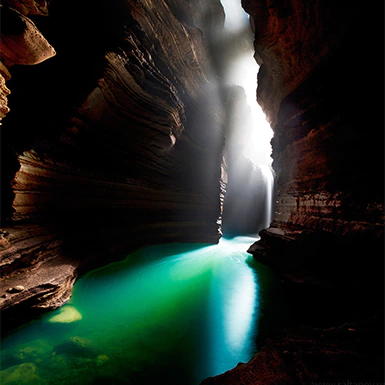
View from the bottom of Gupteshwor Mahadev Cave
Attractions
Cosmic, supernatural shapes made of stones inside the cave tempt the mind. The naturally formed sculptures are the figures of Shiva, Parvati, Vishnu, Lakshmi, Saraswati, Sheshnag, Sumeru Parvat, Bhagwati Bahan, Kalash, Kamdhenu, Garuda Devta, Govardhan Parvat, Krishna Leela deities. Seeing many such forms of God, even an atheist forgets his atheism.
There are also small and big temples like Radhakrishna Temple, Bhajan Mandap, Sattal with a two-storied slope, and Mahavir Temple on the hill. The cave is home to hundreds of bats.
On the descent, there are many images of scenes from the ancient Indian epic Mahabharata. Drill columns adorn various kinds of snakes.
There’s also a mechanical cow, and it’s shed in the cave. The cow is called Kamdhenu, which is made of fiber.
The main attraction of the cave is Devi’s fall, known as Patalo Chhanga in Nepali, which means an underground waterfall as it falls and disappears into the Gupteshwor cave. As these both attractions are very near to Pokhara City, you can schedule a trip during the Annapurna Base Camp Trek and Annapurna Circuit Trek.
It is excellent and humid in the cave itself, and it is delightful after the exhausting closeness of the city. The tourist part of the cave ends with an impressive gap glowing from the sun and Devi’s fall. From the bottom of the cave, it looks much more spectacular.
Comments are closed