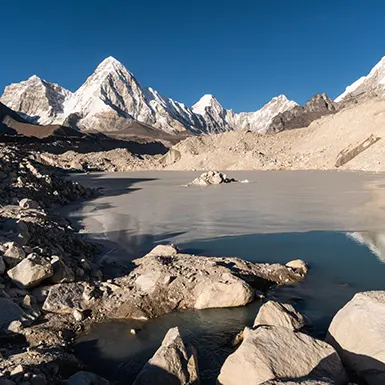
With current global warming projections ranging from 1.5 to 2 degrees Celsius, glacial retreat in the Hindu Kush Himalayas is expected to reach 30 to 50% by the end of the century. However, the report warns that with a global temperature rise of 3 degrees Celsius, the glacial retreat could reach as high as 75%.
This report highlights the significant impact on countries including Nepal, India, China, Bhutan, Myanmar, and Pakistan. “We are losing glaciers at an alarming rate within a century,” stated Philipus Wester, one of the report’s authors.
The Hindu Kush Himalayas span approximately 3,500 kilometers, encompassing countries including Nepal, India, China, Afghanistan, Bangladesh, Bhutan, Myanmar, and Pakistan.
Studying the impact of climate change in the Hindu Kush Himalayas has been challenging for scientists. Unlike the European and South American mountain ranges, where high-tech instruments were readily available to measure glacier growth or decline over long periods, such resources were scarce in this region.
However, the development of satellite-based research systems has made some aspects easier to study. “With the advancement of satellite technology, we are now much more confident in our study’s conclusions than data collected before 2019. We can readily assess the trajectory of the damage that will occur until the end of this century,” stated Wester.

Himalaya – Himalayan Glacial Lake Poses High Risk in 7 Asian Countries
If the glacial retreat in the Himalayas continues unabated, it will affect more than 1.65 billion people in this mountain range, including Nepal, India, China, Afghanistan, Bangladesh, Bhutan, Myanmar, and Pakistan. Scientists have faced significant challenges in studying the impact of climate change in the Hindu Kush Himalayas. Unlike the European and South American mountain ranges, where the highest technology is unavailable, scientific researchers have struggled to gather long-term data on glacial growth or decline in this region.
However, with the development of satellite-based research systems, some aspects have become more accessible. “Now, with satellite technology, we have much more confidence in the conclusions of our studies compared to the past in 2019. We can easily predict the extent of the damage that will occur by the end of this century,” said Wester.
If glacial retreat continues at its current pace, the massive population residing in this region will face severe consequences. Twelve major rivers, including the Ganges, Indus, and Brahmaputra, originate from the Hindu Kush Himalayas. According to researchers, when the water flow increases at higher altitudes during the century, the densely populated areas downstream will be vulnerable to catastrophic flooding.
Studies indicate that over 200 regional glacial lakes are at high risk. Researchers emphasize that if the glacial retreat intensifies, it will also affect the water supply, leading to severe water scarcity. “It will be extremely challenging to manage the situation once a large amount of glacial melt occurs,” warns Pamela Pearson.
Furthermore, she adds, “Unlike ships that can easily navigate rapid currents in the oceans, it is much more difficult to control the speed of glacial retreat.” She recalls the recent incident in the Joshimath area of Uttarakhand, India, where a sudden flood left the local population stranded.
Comments are closed