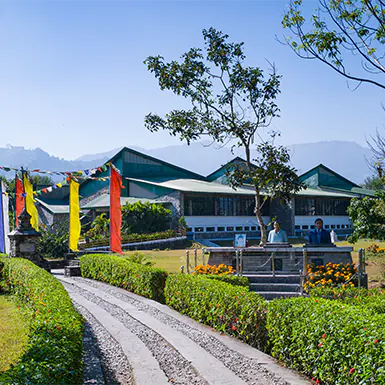
Main Attractions of the International Mountain Museum
1. The Mountain People Gallery
This gallery is on the ground floor and is exclusively dedicated to all things related to the indigenous inhabitants of the mountainous regions of Nepal. This gallery depicts their lifestyles as well as their cultures. This gallery allows visitors to understand the lifestyles of the mountain people better.
During the visit, guides will take you to the video room to orient you and inform you about the culture, the mountains, and the Khumbu Region. The videos are approximately 18 minutes long, and after viewing, visitors are invited to view life-size reproductions of mountain dwellers.
The culture and traditional costumes of Nepalese, Taiwanese, Slovenians, and Japanese will be the major attractions in this gallery. The room also offers comparative studies between the Alps of Europe and Nepal inhabitants.

Ethnic People
2. The Mountain Gallery
The second room is dedicated to the mountains of the world, where visitors can obtain information on national and international mountains and the highest peaks in the world.
This section can find all the documents on the 14 peaks rising over 8,000 meters in height and their photos. This gallery also offers a geological section where visitors will find a collection of rocks unique to the geological formation of the Himalayan Range, as well as replicas of local flora and fauna.
3. The Mountain Activities Gallery
It is in this third room that the equipment, the clothing, and the various professional rope knots are kept. You will find several photos of Maurice Herzog, the first mountaineer to ever succeed in the ascent of a summit of more than 8,000 meters.
You will also find photos of Junko Tabei‘s expedition, made up of 15 women who were the first to climb Mount Everest successfully. Toshio Imanishi, one of the first people to have climbed Manaslu, and other mountaineers accompanied by their equipment are also displayed in this room. Some representations of the fourteen peaks in chronological order of the year they were conquered are also present.
Visitors will find the necessary equipment for the exploration of the mountains as well as information on their uses. On the first floor are publications illustrating the myths surrounding the legendary Yeti.
A section dedicated to safeguarding the ecology and environment in the mountains is near the equipment section. To raise awareness among visitors, Rubbish collected on Mount Everest between 2000 and 2003 was placed upon tourists to demonstrate environmental degradation and neglect of its preservation.
Another section, titled Imaging Everest, takes visitors to a part of the room where visitors will find many photos of British expeditions to Mount Everest from 1921 to 1953. The Royal Geographical Society provided these images.
4. Lakhang
The Lakhang Hall is dedicated to visitors who want to know everything about the Buddhist religion. There is a room dedicated to prayers, and the right of the Lakhang room is a library section where students and researchers can consult many books on the subject.
5. Gallery of associates
This gallery offers information on socio-economic life and the activities according to the times of the people living in the mountains. It also gives information on the current projects and plans for conserving the sustainable environment in the region.
Here, you can find the past, present, and future actions of the UCIN and ICIMOD associations. Visitors and students can also take the mountain quiz to test their knowledge.
6. The miniature model of Mount Manaslu
With the contribution of the Japan International Cooperation Agency, the museum has built a miniature model of Mount Manaslu. Its height is almost 10 meters, and visitors can climb on it or take pictures. There is also information about the first Japanese explorers who climbed the mountain in 1956 near this model.
At the center of the museum is a vast mandala preserved under glass. Mandalas are decorations created with colored sand, a refined work practiced by Buddhist monks for centuries. The characteristic of the mandala is that it is destroyed as soon as it is completed, as a reminder that everything ends and nothing last forever.
Also, on the territory of the Museum of Mountaineering, there is a hotel and a restaurant, and for lovers of books in the museum, there are manuals on geology, fauna, flora, and culture.

The miniature model of Mount Manaslu
How to get to International Mountain Museum?
The best way to get to the International Mountain Museum is to take a taxi from the center of Pokhara. A bus is cheaper, but getting to the museum from the nearest stop is likely long and exhausting.
Schedules and Entrance Fee
The museum opens daily from 9 in the morning to 5 pm. Entrance to the museum costs NPR 500 per person for foreigners and NPR 100 for Nepali citizens. It is possible to buy entrance tickets on-site until 4.30 pm.
Comments are closed